
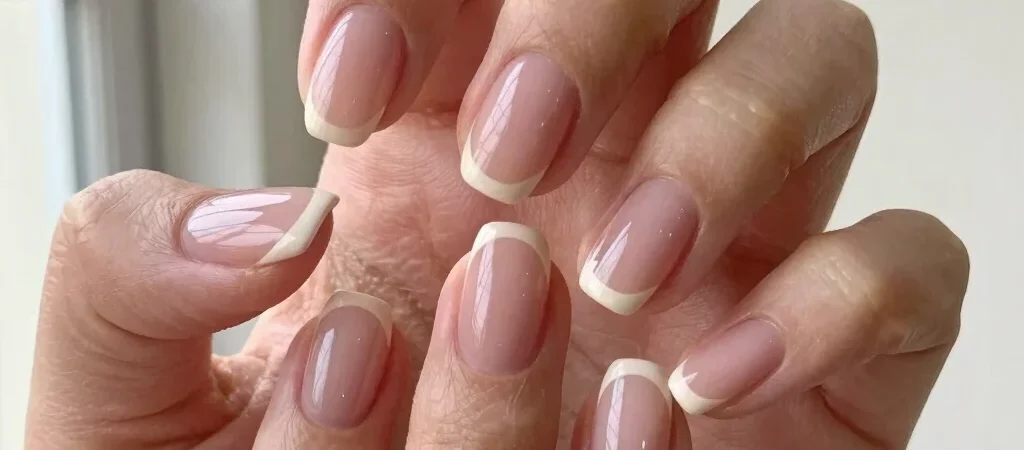
A French tip changes character when the white line is reduced to a fine edge. On a short nail, that narrow curve leaves more room for the natural nail color to show; on a longer nail, it can read as a crisp outline. The design depends less on a perfectly matching set than on keeping each tip in proportion.
Start with the nail shape
Look at the free edge before choosing the curve. A softly rounded tip usually pairs naturally with a shallow arc, while a squarer edge can carry a straighter line with gently softened corners. Keeping the white band narrow helps the shape remain the focus.
Steady the fine line
After base color is fully dry, rest your painting hand on a table and turn the finger rather than reaching across the nail with the brush. Use a fine liner brush and a small amount of polish, then sketch the curve in short strokes from one side toward the center. If the line looks too thick, tidy its lower edge with a clean brush and a little base color.
Keep the contrast intentional
Bright white over a sheer pink gives the most familiar contrast, while an ivory tip feels softer against a milky nude. A muted color such as slate blue can make the same fine curve feel more like an outline than a classic French manicure. Try the line on one nail first and check the hand from a little distance before repeating it.