
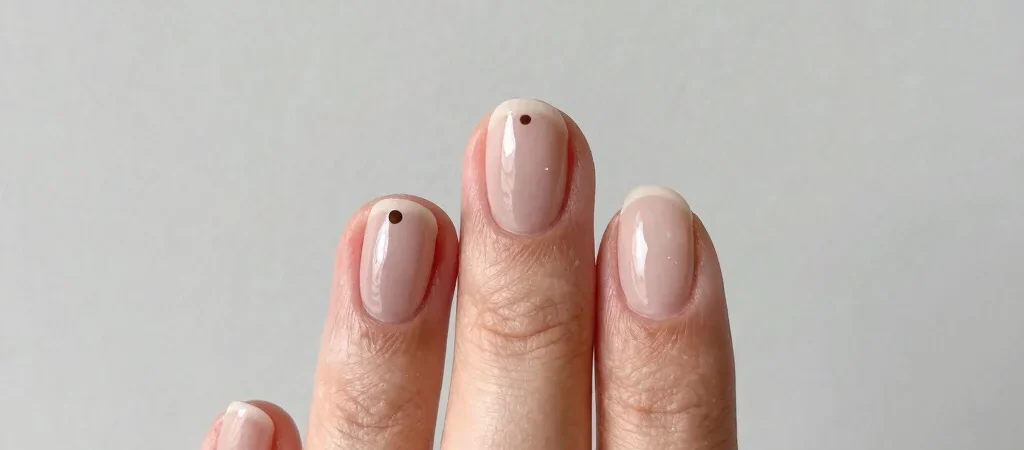
Some nail designs are strongest when most of the nail is left alone. A small dot against a sheer or bare-looking base gives the eye one clear place to land, and its position can change the whole mood: centered feels composed, while an off-center detail has more movement. It is a small design with little room to hide unevenness.
Make the base feel deliberate
A clear coat, a sheer beige, or a muted pink can all work as a quiet background. Choose a base that looks even in daylight, then let it dry fully before adding the dot. Keeping the cuticle area neat matters because the open space makes the edges of the manicure more noticeable.
Place dots with intention
A dotting tool gives a round mark; a small amount of polish on its tip is usually easier to control than a loaded brush. Set the dot down in one motion and lift straight up, then give it room from the cuticle and sidewalls. For a balanced hand, you can repeat the placement on each nail or use one accent nail and leave the others plain.
Tune the color and scale
A deep brown or ink blue dot on a milky base feels graphic, while a soft terracotta or muted green reads more quietly. If the mark feels too dominant, reduce its size before adding more details; if it disappears, try a slightly stronger contrast. Step back and look at the hand as a whole—the negative space is part of the composition, not an unfinished area.